
Early County Court Records After Arrest
Early County court records after a jail arrest should be read as the case record, not as a live jail roster. A person arrested by the Early County Sheriff's Office, Blakely police, Georgia State Patrol, or another local agency may be booked at the Early County jail inmate records point when county custody applies. That custody entry can help confirm the arrest, but it does not settle the filed charge. The formal court record starts to matter once a judge, clerk, and prosecutor handle bond, first appearance, accusation, indictment, plea, motion, dismissal, sentence, or other case action.
Early County is part of the Pataula Judicial Circuit. The Pataula Judicial Circuit District Attorney prosecutes state criminal cases for Early, Clay, Miller, Quitman, Randolph, Seminole, and Terrell counties. The DA page lists Ronald "Vic" McNease, Jr. as District Attorney and places the Blakely office at 12850 Magnolia Street. The key split is simple: the jail can confirm custody or a booking fact, while the clerk and court file show what was actually filed after the arrest.
Early County Court File Search
No confirmed public Early County defendant-name criminal case portal was found in the official sources reviewed. The statewide Georgia Courts E-Access page is still useful because it routes users to electronic access providers where a court participates, but it is not a promise that Early County criminal case records can be searched online by name. If E-Access does not lead to a usable provider record, the next local source is the Early County Clerk of Superior Court.
The Pataula Judicial Circuit clerks page identifies the Early County Clerk of Superior Court as Gayle Anderson. The clerk contact is 229-723-3033, fax 229-723-4411, P.O. Box 849, 111 Court Square, Suite C, Blakely, GA 39823, and gayle.anderson@gsccca.org. Use a full legal name, aliases, date range, arrest date, charge, and case number if known.
The Georgia Courts E-Access routing page is the matching public source for the provider limits shown here.
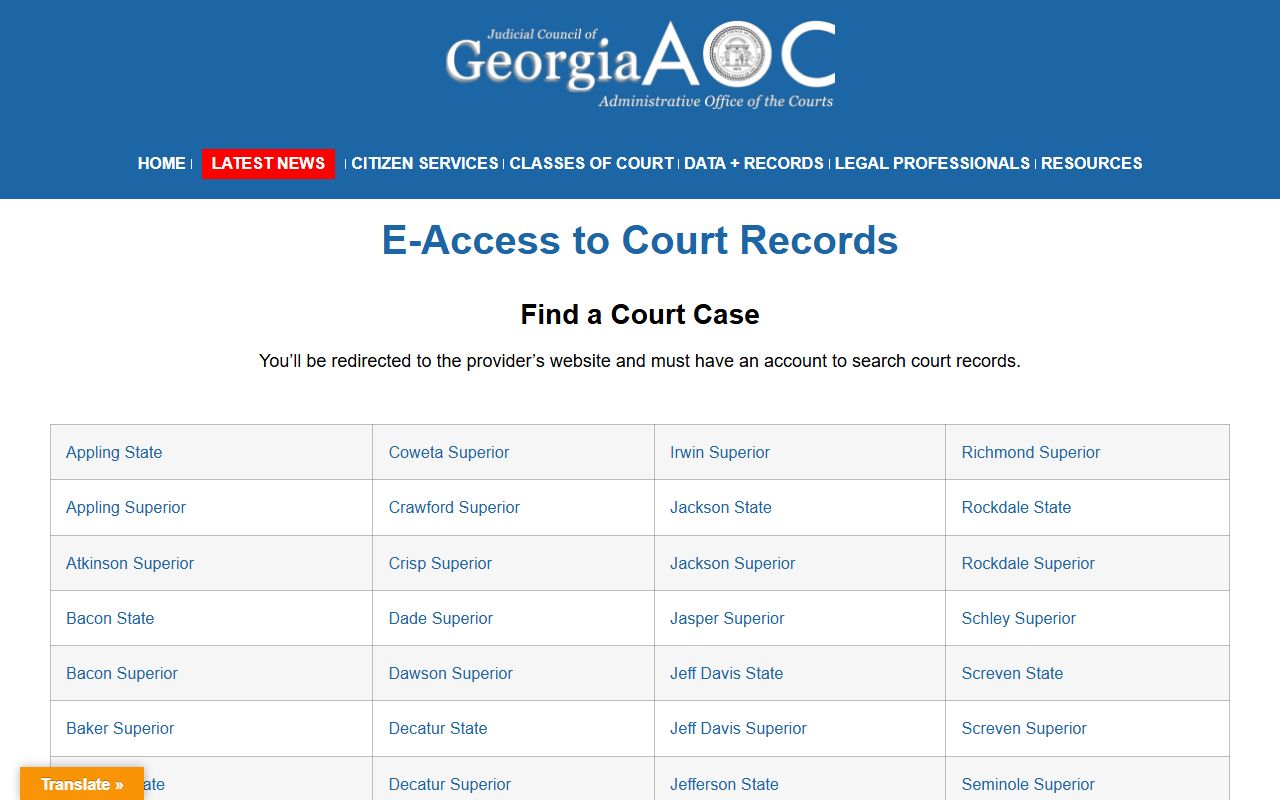
The screenshot reflects the state-level routing role: use it to identify possible provider access, then fall back to the Early County Clerk when the court file is not available through a confirmed online search.
| Source | Field or Detail | Use | Limit |
|---|---|---|---|
| Georgia Courts E-Access | Provider or court selection | Routes to participating court providers | No single statewide trial-court field set applies to every county |
| Early County Clerk | Defendant name | Main local lookup detail | Use full name and aliases when possible |
| Early County Clerk | Case number | Best way to narrow the file | May come from notice, attorney, citation, or earlier jail/court contact |
| Early County Clerk | Date range, arrest date, charge | Helps staff locate matching court records | Not a substitute for a confirmed case number |
Early County Arrest Charges Filed
The arrest charge is not always the filed court charge. Early County Jail can have booking information tied to intake, while the Pataula Judicial Circuit DA decides how felony or state prosecutions move forward. Georgia practice may involve an accusation, indictment, complaint, warrant, or other charging paper depending on the charge level and procedural path. A complaint or warrant can support the arrest or early charge, but it may not be the last word on the case.
| Complaint or Warrant | Accusation | Indictment | |
|---|---|---|---|
| Filed By | Officer, court, or prosecutor path | Prosecutor | Grand jury |
| Common Role | Supports arrest or early proceedings | Formal charge without grand-jury indictment | Formal grand-jury charge |
| What to Check | Issuing court, warrant type, arrest date | Charge count, statute, filing date | Count list, filing date, arraignment path |
| Why It Matters | May differ from final filed charge | Shows what the DA chose to prosecute | Shows charges returned by grand jury |
The Pataula DA office should not be treated as the jail roster. It is the prosecution office for filed-charge status, victim assistance, and prosecution routing. The official DA page says case-specific information should not be left in website comments, so direct office contact is the better route for prosecution questions.
Early County Charge Status Records
Charge status can change after arrest. A jail booking entry may keep the intake language, while the court case can show amendments, reductions, dismissals, nolle prosequi entries, pleas, acquittals, convictions, or sentence orders. Pending means no final disposition has been entered. Nolle prosequi means the prosecutor declines to proceed.
| Status | What It Means | Where It Belongs |
|---|---|---|
| Pending | The filed charge has not reached final disposition. | Court docket or clerk file |
| Amended or Reduced | The prosecutor or court changed the charge or severity. | Court order, plea, or docket entry |
| Dismissed | The charge ended without a conviction by court or prosecutor action. | Court disposition |
| Nolle Prosequi | The prosecutor chose not to proceed on that charge. | Prosecutor and court disposition record |
| Convicted | Guilt was established by plea or verdict. | Court judgment and sentence record |
For a broad Georgia criminal-history check, the local sheriff background-check page says Early County assists with State of Georgia checks for $20 cash and requires government-issued picture ID. That check is a different record category from a new court file. It may include identification data, arrest data, charges, final judicial disposition, and custody information if the person is in a Georgia correctional facility, but it is not the fastest path for a new arrest or first appearance.
Early County Bond Court Records
Bond records connect the jail and court sides of an arrest. Early County's sheriff pages do not publish a dedicated bond schedule, public bond lookup, bond payment-method list, or bond-posting hours. The safest local first step is to call Early County Jail at 229-723-3150 and ask whether the person is in custody, whether bond has been set, whether any charge is no-bond, and whether another agency hold blocks release. Do not rely on commissary kiosk or inmate-account payment details as bond instructions unless jail staff confirms them.
The sheriff victim-assistance material explains bond as money or property used to ensure a defendant appears in court. Judges can consider flight risk, danger to the community, the risk of another crime, and witness threats. If a defendant has not made bond within 72 hours, most appear before a judge. Some serious crimes require bond to be set by a Superior Court judge after notice to the DA.
| Bond Type | How It Works | Early County Checkpoint |
|---|---|---|
| Cash Bond | Money is paid to secure release and court appearance. | Confirm where and how payment must be made. |
| Surety Bond | A bonding company or surety posts the bond. | Ask whether bonding-company posting is allowed for the charge. |
| Property Bond | Allowed property value secures the court appearance. | Confirm court requirements before relying on it. |
| PR Bond | Release on promise to appear, often with conditions. | Look for court-set conditions in the file. |
| No-Bond or Hold | Release is blocked until a court or outside agency clears it. | Ask about warrants, probation, parole, federal, or ICE holds. |
Early County Arrest Warrants
No official Early County active-warrant search form was located on the sheriff pages reviewed. The sheriff departments page says administration handles civil processes and warrants, and the public-resource page mentions most wanted and missing persons, but it does not provide a confirmed searchable warrant database. For warrant-record routing, use the sheriff or dispatch number at 229-723-3577. For someone believed to be in custody after a warrant arrest, call the Early County Jail line at 229-723-3150.
Bench warrants are court-issued warrants, often tied to failure to appear or court noncompliance. They may not appear in a sheriff public list even when they affect a jail booking. For bench warrants or filed court records after an arrest, the Early County Clerk of Superior Court is the more precise source.
Note: Clearing a warrant is a legal matter; use the court, clerk, jail, or an attorney rather than unofficial databases.
Early County Charges vs Convictions
An arrest and charge are not a conviction. A charge means the state has accused a person of an offense. A conviction requires a guilty plea, a verdict, or another legally recognized finding of guilt. This distinction matters because a booking charge can remain in one record while the court file later shows dismissal, reduction, nolle prosequi, acquittal, or conviction.
| Charge | Conviction | |
|---|---|---|
| Stage | Accusation or allegation after arrest | Final guilt by plea or verdict |
| Proof Level | Probable cause or formal filing threshold | Beyond a reasonable doubt, or admitted by plea |
| Record Source | Booking record, charging paper, docket | Judgment, disposition, sentence order |
| Can Change? | Yes, it can be amended, reduced, or dismissed | Changes require court action, appeal, restriction, or other legal process |
Sealed vs Expunged Records
Georgia usually uses the term record restriction rather than expungement for many criminal-history records. O.C.G.A. § 35-3-37 allows eligible Georgia arrest and criminal-history information to be restricted from general public access without destroying the record. Juvenile cases, sealed court files, certain dismissed matters, and active investigation material can have separate access limits.
| Restricted or Sealed | Expunged | |
|---|---|---|
| Visibility | Hidden from general public access when approved or required by law | Often used to mean destroyed or treated as though it did not exist |
| Georgia Context | Record restriction is the key Georgia criminal-history term | Do not assume full destruction from a dismissal alone |
| Law Enforcement Access | May remain available to authorized agencies | Depends on the exact order and law |
| Eligibility | Depends on outcome, charge, timing, and statutory criteria | Requires a specific legal basis or order |
Georgia's Open Records Act, including O.C.G.A. § 50-18-70 et seq. and the timing and fee rule in O.C.G.A. § 50-18-71, still leaves room for exemptions. State guidance says agencies generally must respond within three business days or explain availability, timing, and cost. The sheriff open-records page adds a local caveat: people seeking case information for a person awaiting trial may need the Early County Clerk of Superior Court and appropriate discovery motions.
State and Federal Custody
Not every arrest path stays in the Early County court and jail system. If a person is sentenced to a Georgia prison or transferred to state custody, current custody lookup shifts to the Georgia Department of Corrections offender query. Federal and immigration custody are separate. The BOP inmate locator covers federal inmates from 1982 to present, while the ICE Online Detainee Locator System uses A-number and country of birth or exact biographical fields. An Early County court file may mention a hold or detainer, but it may not show the person's later state, federal, or immigration location.
Important: Early County Inmate Population is not a consumer reporting agency and cannot be used for credit, employment, housing, insurance, or other FCRA-covered decisions.